
Thursday, November 13, 2014
north gives flesh to wind


Tuesday, May 13, 2014
SciFi & Beyond!
Honestly, it was fantasy novels that I devoured as a kid. I didn't always like the real world so much, so taking refuge among albino sorcerers, wayward talking cats, and elder gods was vital then and still has impact today. Since then, I've taken many English classes, have taught English, and have read a lot of writing which eschews the realms of the weird and unreal. But science-fiction, fantasy, and the weird are incredibly important. These genres often allow our culture to have a dialogue around things that otherwise may go ignored or are felt in the culture but have yet to be defined.
 Early (first-wave) Gothic literature was a direct reflection of those in positions of power (read land-owners / nobility) nervous about losing their place in the social structure. Thus we have stories like Walpole's Castle of Otranto re-affirming, through haunted armor, ghostly wails, etc., the rightful heir to some property and sticking it to the upstart usurper. Today we have television shows like Supernatural, which after a few seasons devolved into various powerful, and often times corporate, camps vying for power through deception, intimidation, resource-control, genetic tinkering, and sometimes force--sound familiar?
 That said, there are a lot of poorly written, but very popular, scifi, fantasy, and slipstream books out there just as there are a lot of well-written, but sometimes less known, books of the same genres. As a librarian directly involved in collection development, sometimes this can be a challenge--what to purchase for a collection and how to recommend it? Luckily, an intrepid few, myself included, have started a blog, SciFi & Beyond, which provides reviews and essays on science-fiction, horror, fantasy, and the weird. It's a fun work-in-progress and is a great place to visit in the internets if you are looking for some great reviews and insights.

That said, there are a lot of poorly written, but very popular, scifi, fantasy, and slipstream books out there just as there are a lot of well-written, but sometimes less known, books of the same genres. As a librarian directly involved in collection development, sometimes this can be a challenge--what to purchase for a collection and how to recommend it? Luckily, an intrepid few, myself included, have started a blog, SciFi & Beyond, which provides reviews and essays on science-fiction, horror, fantasy, and the weird. It's a fun work-in-progress and is a great place to visit in the internets if you are looking for some great reviews and insights.
Take a look here, and let us know what you think!
Wednesday, April 30, 2014
Librarians talking about ALA Annual 2014
I am really excited about the American Library Association's annual conference this year! And so are these fine people! Annual conferences are always super rewarding, and there are so many reasons to make your way there--one being that the fantastic Kyle Cassidy (whose librarian photos can also be found on Slate) will be there to take pictures of any and all who would like to share with others.
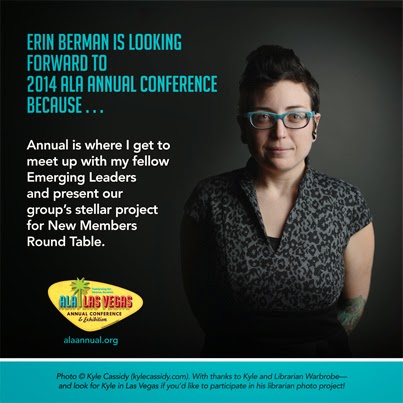


If you are going, let's meet! Let's talk about libraries, literacy, youth advocacy, technology, comic books, reference, whatever! And I bet the same goes for most you'll meet at the conference. Oh, and pro-tip: if it's your first time, find some New Member Round Table meetings--I've been going for a few years, and I still learn a lot from NMRT meetings and socials! And, with full transparency as I am a member, don't forget to come by ALAPlay!
If you are going, let's meet! Let's talk about libraries, literacy, youth advocacy, technology, comic books, reference, whatever! And I bet the same goes for most you'll meet at the conference. Oh, and pro-tip: if it's your first time, find some New Member Round Table meetings--I've been going for a few years, and I still learn a lot from NMRT meetings and socials! And, with full transparency as I am a member, don't forget to come by ALAPlay!
Tuesday, April 15, 2014
Null Set by Steven Seidenberg
Spooky Actions (for which I am an editor) has published a new book by Steven Seidenberg titled Null Set. It's a hand-stitched chapbook in three sections with an accordion-fold cover with art by Sarah Hobstetter.

It's a gorgeous book with gorgeous (though sometimes disruptive, energetic, troubling ) poems which I really do think you should read! Intrigued? Click here to go to the Spooky Actions site!
Want a copy for reviewing purposes? Send me an email!
Monday, February 03, 2014
A brief review of the American Library Association Mid-winter 2014 Conference

 |
| from the Latvian Society of Pennsylvania. EveryLibrary / Mango Afterhours Film Fest |
This year, I decided to dip my toes into getting involved. And it could not have been a better choice! I wish I had done so sooner! I learned so much about the structure of ALA by attending the New Members Round Table; was excited to help plan events for the annual in Las Vegas, and was stoked to help work on a beginning stage of a youth advocacy packet with YALSA. Not only that, but attending library-related social events meant that I could meet so many interesting people who were just as interested as I am in similar things--everything from a Tublarian meet-up to a YA librarian social at the Mutter Museum to dinner with friends at great restaurants.
ALA's next conference is in Las Vegas, and if you're an information professional, not only do I think you should go, but I think you should get involved! People want to hear you, want to talk with you, and want to share ideas with you--you just have to start a conversation. And if you're going to the summer conference, let's talk!
Tuesday, January 14, 2014

Wednesday, December 11, 2013
Thor: god of thunder review
Thor: God of Thunder /
The god butcher
Collects issues #1-5
Jason Aaron & Esad Ribic
$24.99 (Hardback)
124 pages
With the popularity of Marvel Comic's movie machine, Thor is certainly gaining some readers. For those interested in what propels this character, Jason Aaron's run of Thor: God of Thunder is a great place to start. The narrative twines three versions of Thor from different times in his life. We get to know the young Thor who cannot yet lift Mjolnir, the Avenger's Thor, and finally a older almost broken Thor (now one-eyed and ruling what's left of Asgard).
 These stories are held together with a villain named, rather bluntly, Gorr, but who nonetheless is an intriguing character: during one scene in which he's bound our young Asgardian hero and is busy inflicting pain, Gorr is interrupted by Thor's followers and pleads with the berserkers to not fight as he is trying to free them, insisting, "Do not throw your lives away on something as useless as a god! He isn't worth your devotion!" Gorr thinks mortals' lives would be better without any gods and all and is busy ridding the universe of what he considers a dangerous pest. As the story progresses, Aaron deftly builds our sympathy while balancing the actual atrocity of this character's actions--intent and impact on a cosmic scale.
Supporting Aaron's writing is Esad Ribic's art (who some may recognize from Wolverine, Loki, and Uncanny X-Force). His work here is impressive--adeptly shifting perspectives and including enough detail to encourage looking again without drowning the composition. Colorists Dean White and Ive Svorcina need a shout here as well as coloring is gorgeous.
While the first trade-paperback is a pretty fast read, the series is in-depth and worth checking-out, and is a good addition to your library's (or your own) collection.
Subscribe to:
Posts (Atom)